The history of mirrors | Business History Documentary
By Kiron Kasbekar | 06 Oct 2026
Today, there is usually a mirror a few steps away from wherever you sit at work or lie down to rest.
If you step out of the house forgetting to groom yourself in the bathroom, it’s fine. There is a mirror in the elevator. A mirror in the car. The selfie screen on your mobile phone.
Women often carry small mirrors in their handbags, while men make do with whatever reflective surface they can find.
Nobody in today’s world thinks twice about it. It is just a mundane, day-to-day act of checking whether your appearance is presentable.
But for over ninety-nine point nine percent of human history, people rarely saw an accurate image of themselves.
Most people simply watched their faces quiver as the slightest breeze caused the water in a pond to ripple.
To get from the muddy ponds of antiquity to the perfectly flat glass reflecting your face today required thousands of years of innovation.
It required deadly chemicals, global industrial espionage, fiercely guarded trade secrets, and massive technological revolutions.
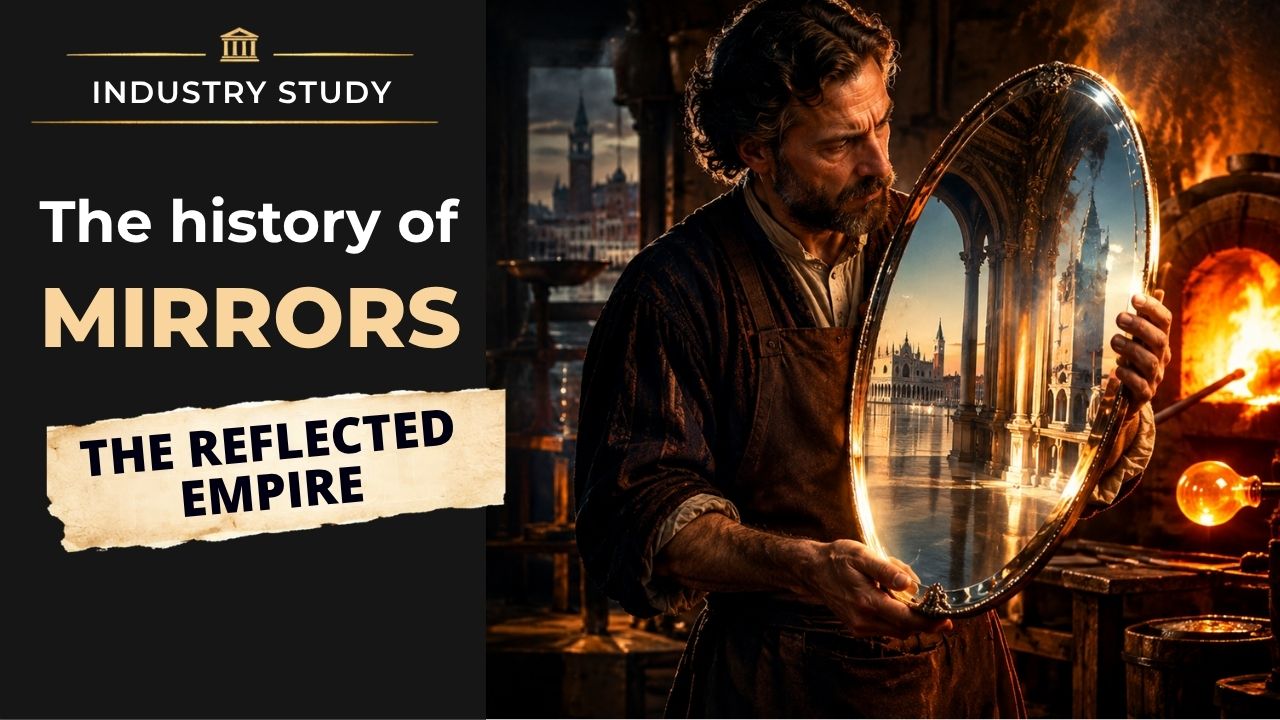
Welcome to Business History. Today, we break down the history of mirrors. From the volcanic glass of prehistoric settlements, to the toxic workshops of medieval Venice, to the multi-billion-dollar glass factories that reflect the modern world.
CHAPTER 1: Water and mythology
For hundreds of thousands of years, humans had no way to manufacture mirrors. In order to obtain reliable reflections, they had to turn to surfaces like still lakes, quiet rivers, rain pools, and sheltered springs.
Water became humanity's first mirror. Because of this, many cultures treated water and mirrors as spiritually equivalent.
Greek mythology narrates the tale of Narcissus, a very handsome and arrogant youth who rejected everyone who loved him, including the nymph Echo.
Echo’s love for Narcissus knew no bounds. While she suffered because of his rejection, she did not stop loving him.
Nymphs were considered minor female nature deities in ancient Greek folklore, acting as personifications of nature. Distressed by Echo’s plight, other nymphs called upon Nemesis, the goddess of retribution, to punish Narcissus.
As a result of the punishment, Narcissus encountered a perfectly still spring and fell hopelessly in love with his own reflection, not realizing it was himself. Remember, there were no manufactured mirrors then.
Unable to possess the evanescent image, Narcissus gradually wasted away and died. A narcissus flower grew where he perished.
The story has several angles. While the pool functions like a mirror, the water becomes a flawless reflector, a deceiver, a symbol of illusion, and a boundary between reality and appearance.
This tale has been used countless times by later philosophers to describe vanity, the deceptive nature of appearances, and to criticize those who are selfish and self-centered.
Greek priests even interpreted unusual reflections or disturbances on the water's surface as messages from the gods. Water and mirrors became interchangeable tools for seeing beyond ordinary reality.
CHAPTER 2: Ideal minds and prehistoric stone
Ancient Chinese philosophy also drew deep meaning from reflections. They often compared an ideal mind to absolutely still water, seeing it as reflecting everything without distortion.
They said that a disturbed pool represented emotional turmoil. A calm pool represented wisdom. This metaphor became a key part of both Daoist and Buddhist thought.
Imperial Chinese gardens often included reflective ponds designed to function as natural mirrors, expressing harmony between heaven, earth, and humanity.
But eventually, humanity learned to manufacture the reflection.
During the nineteen-sixties, archaeologists excavating the Neolithic settlement of Çatalhöyük in modern-day Turkey made a stunning discovery. They found polished obsidian mirrors dating back to six thousand B.C.E. That is about eight thousand years ago.
They were made from obsidian—a jet-black volcanic glass. Producing these mirrors required selecting suitable volcanic glass, cutting and shaping it, grinding away imperfections, and polishing it until it produced a reflective black surface.
Although the reflective quality was far less than modern glass, they represented an extraordinary technological achievement for that ancient period.
As you can imagine, since volcanoes were not a common occurrence, these mirrors remained rare. They were valuable luxury goods rather than everyday objects. Only a privileged few could afford them.
CHAPTER 3: Copper, Bronze, and Secret Alloys
As people learned metallurgy, stone was gradually replaced by polished metal. This happened in the ancient civilizations of Egypt, Mesopotamia, China, India, Greece, and Rome.
Artisans began to craft mirrors from polished copper, bronze, or brass. They were typically circular polished disks, often with decorative handles and engraved backs.
Egyptian mirrors dating to three thousand B.C.E. closely resemble modern handheld mirrors. But they were more than grooming tools; they were profound symbols of life and rebirth.
Crafted from polished bronze, copper, or silver discs, their reflective, sun-like surfaces represented the sun's regenerative power. In fact, the Egyptian word for mirror was a homonym for ‘life’.
Handles, often made of wood or ivory, were intricately carved as papyrus plants—evoking the primeval swamp of creation—or as the goddess Hathor, embodying fertility and renewal. This deep spiritual significance made mirrors essential burial goods.
Chinese bronze mirrors also became especially sophisticated. During the Han dynasty, from two-hundred-and-six B.C.E. to two-hundred-and-twenty C.E., artisans developed highly polished bronze alloys.
They were often decorated with intricate geometric and mythological designs on the reverse. Chinese artisans also discovered that adding carefully measured amounts of tin produced exceptionally bright bronze.
Much later, Indians developed remarkable mirror-making traditions. The most famous of these is the Aranmula Kannadi, produced in Kerala.
Aranmula Kannadi contains no glass at all. Instead, it consists of a highly polished metal alloy whose precise composition remains a closely guarded family secret among a handful of artisan families today. These mirrors are highly prized luxury objects.
CHAPTER 4: Mesoamerican magic and pyrite
In some ancient cultures, people believed that reflections revealed hidden truths, connecting the living with the supernatural. Ancient Greeks, Romans, and Mesoamericans believed that reflections in pools of water actually reflected their souls.
Among the ancient Aztecs, polished obsidian mirrors and dark pools were associated with the deity Tezcatlipoca, whose name literally translates to ‘Smoking Mirror’.
For the ancient civilizations of Mesoamerica, mirrors possessed extraordinary power. They believed they were windows into another reality, where gods, spirits, and hidden destinies could be glimpsed.
Mirrors occupied a unique position among the Maya, Aztecs, Purépecha, and many other pre-Columbian cultures. They lay at the intersection of religion, science, art, and political authority.
‘Mirror’ divination began with the remarkably simple means of using a bowl filled with still water as a reflective surface in which priests tried to see messages from the supernatural.
This practice survived for centuries, and was still widely observed when the Spanish arrived in the region in the early sixteenth century.
These Mesoamerican people also made the earliest mirrors in Central America from single pieces of highly polished pyrite—an iron ore that had a brassy yellow luster.
When carefully ground, the pyrite produced remarkably clear reflections. However, it required exceptional craftsmanship, making these mirrors incredibly rare, prized possessions of the elite.
Across all these ancient cultures, the exact same ideas recurred: A calm surface meant truth. A deep pool meant hidden knowledge. A reflection was identity. And a disturbed or tarnished mirror represented illusion and moral disorder.
That is history. Nobody does that anymore. Now, people check their looks in a matter-of-fact way before leaving home for a business meeting or a party.
CHAPTER 5: The secrets of murano
Then real mirrors began to make their appearance. But they were still rare, expensive, and far from perfect. For most of human history, the dream of producing a bright, clear reflection remained elusive. That changed dramatically during the Renaissance, when a remarkable technological revolution unfolded on a small island in the Venetian lagoon.
From the thirteenth century onward, Murano became Europe's unrivaled center of fine glassmaking. Concerned about the fire risk posed by roaring glass furnaces in a wooden city, the Venetian Republic ordered the city's glassmakers to relocate there. The move unintentionally created one of history's greatest centers of glassmaking innovation.
Protected by the waters of the lagoon and closely watched by authorities, Murano's craftsmen developed techniques that transformed glass from a practical material into an object of extraordinary beauty.
Among their greatest achievements was the perfection of cristallo—an exceptionally clear, almost colorless glass unlike anything produced elsewhere in Europe. It provided the ideal foundation for a revolutionary new type of mirror.
During the fifteenth and sixteenth centuries, Murano artisans perfected a painstaking process. They coated the back of flawlessly polished glass with a thin layer of tin-mercury amalgam.
Producing these mirrors demanded exceptional skill. Sheets of tin were carefully laid. Liquid mercury was spread evenly across the surface. Finally, the finished mirror was polished until it reflected with astonishing brilliance.
The results were breathtaking. For the first time, wealthy Europeans could see themselves with a clarity that earlier generations could scarcely have imagined.
Venetian mirrors rapidly became among the most prized luxury goods of the Renaissance.
Some of the largest Venetian mirrors commanded prices comparable to masterpieces painted by the greatest artists of the Renaissance.
Nobles, merchants, and monarchs competed to acquire them.
Venice understood precisely what it possessed. Mirror-making was treated as a state secret.
Murano's master craftsmen enjoyed exceptional wealth and prestige, yet lived under strict supervision. Leaving the republic without permission was forbidden, and those who attempted to reveal trade secrets faced severe penalties.
In effect, Europe possessed one of its earliest examples of industrial espionage and technology protection.
CHAPTER 6: The hall of mirrors
But no monopoly lasts forever. Throughout the seventeenth century, ambitious European rulers sought to break Venice's dominance.
None pursued the goal more vigorously than France.
Under the energetic direction of Jean-Baptiste Colbert, finance minister to King Louis XIV, the French government established a royal mirror manufactory in sixteen-sixty-five.
Skilled Venetian craftsmen were quietly—and sometimes secretly—persuaded to cross the Alps despite the massive risks to their lives.
The success of the enterprise was spectacular. Its greatest triumph appeared in the Palace of Versailles, where the magnificent Hall of Mirrors dazzled visitors with an endless procession of reflections.
Vast mirrors multiplied the glow of thousands of candles, turning architecture itself into a display of light, power, and royal magnificence.
The royal manufactory eventually evolved into Saint-Gobain, which remains one of the world's largest producers of glass and construction materials today.
Yet behind the glitter lay a grim reality.
The tin-mercury process exposed generations of craftsmen to highly toxic mercury vapor. Many suffered tremors, neurological disorders, kidney damage, and shortened lives without understanding the cause.
The very material that created Europe's finest reflections slowly poisoned the artisans who made them.
CHAPTER 7: Silver and float glass
The solution emerged in eighteen-thirty-five through the work of German chemist Justus von Liebig.
He developed a method of chemically depositing a microscopically thin layer of metallic silver onto glass.
The innovation eliminated the need for the dangerous mercury process, while producing brighter, more durable, and less expensive mirrors. Silver-backed mirrors rapidly spread around the world and established the basic principle still used today.
But one final challenge remained. Even the finest reflective coating required perfectly flat glass.
That breakthrough came after the Second World War. British engineer Alastair Pilkington developed the revolutionary float-glass process, allowing molten glass to glide across a bath of liquid tin.
Before float glass, every large sheet had to be painstakingly ground and polished by hand. The new process allowed gravity itself to create an almost perfectly flat surface, eliminating most of that work.
Commercial production began in nineteen-fifty-nine, and the impact was profound.
The float-glass process not only revolutionized mirror manufacture, but also transformed modern architecture, making expansive shop windows, towering office façades, and wall-sized mirrors both practical and affordable around the world.
CONCLUSION: The practical magic
Mirrors are not for grooming alone. They are vital parts of automobiles, telescopes, spacecraft, laser laboratories, and astronomical observatories.
They allow dentists to inspect patients' teeth, and surgeons to operate with precision. They allow astronomers to peer into distant galaxies, and physicists to manipulate beams of light.
With the hazy, unpolished mirrors of ancient times, there was just enough room for shamans and priests to interpret the haziness in different ways, treating them as windows to the supernatural.
For most people today, a mirror is an everyday object. This may well be because modern mirrors are so brilliantly reflective that they do not leave any doubt about what is reflected.
The old magic has gone. The practical remains.
The history of the mirror is therefore far more than a story of vanity. It is a story of scientific ingenuity, guarded industrial secrets, hazardous working conditions, and relentless technological improvement.
Every reflection tells the story of one of humanity's greatest manufacturing achievements—a polished legacy of centuries of innovation that began in the secret workshops of Murano and continues in the high-technology glass factories of today.