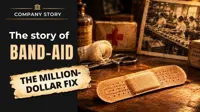
The million-dollar fix: The story of the Band-Aid
By Kiron Kasbekar | 07 Oct 2026
If you didn’t already know what it was, you might well have imagined that a Band-Aid was something drummers used to beat their drums and strike the cymbals. Or something that aided bands of robbers or hoodlums. No. It wasn’t anything like that.
Around a hundred years ago, a hassled husband trying to stop his wife from bleeding profusely after cutting herself in the kitchen accidentally created one of the most successful medical products in history. Ironically, it was a product designed specifically for accidents.
A minor accident, like scraping one’s knee or cutting a finger. Note: I said cutting, not cutting off. In other words, minor injuries.
The inventor was Earle Dickson, who was working at Johnson & Johnson, the US-based medical technologies firm. He was not a scientist. He worked with the company as a cotton buyer.
Yet his improvised creation became one of Johnson & Johnson’s iconic brands, eventually gaining such massive global recognition that its name entered the dictionary as a generic term.
Welcome to Business History.
Today, we explore the extraordinary journey of the adhesive bandage. From ancient remedies and cumbersome medical wraps… to a frustrated husband in a 1920s kitchen… and finally, to the cramped quarters of the Apollo 11 spacecraft. Today, billions of adhesive bandages are used around the world. Yet the entire industry began with one man, one kitchen, and recurring kitchen accidents.
CHAPTER 1: The bloody past
All animals suffer cuts and wounds, and they have their own ways of dealing with them. Mostly by licking them.
Humans behaved just like animals for hundreds of thousands of years.
Then, with time and experience, humans realized that they could use other ways to treat wounds. One of the earliest methods was applying materials like the sap of plants and herbs.
Ancient Egyptians, Greeks, and Romans used substances like honey, animal fats, and plants like willow and aloe to treat their injuries.
There are, of course, other natural remedies, such as applying turmeric powder on a slight cut, which has been a very useful remedy for ages in the Indian subcontinent.
People covered wounds with rudimentary wraps made from cloth or animal hides. If that didn’t do anything else, it at least kept the flies away.
Then, the late nineteenth century witnessed the advent of antiseptic practices. Sterilization and more advanced wound dressings began to emerge.
Doctors and nurses used sterile gauze and cotton dressings to protect wounds and prevent infection; but these dressings were cumbersome.
They required the patient or medical personnel to tape or wrap the dressings securely in place. Otherwise, they would unravel and expose the wound.
There was an obvious need for a more convenient solution for wound care that could be easily used by people who didn’t have any medical training.
CHAPTER 2: The kitchen counter invention
Today, most middle-class households keep a pack of adhesive bandages in their emergency safety kits, alongside other medicines, to treat a hurt or illness at home. The idea is to avoid rushing to see a doctor.
But simple as they might sound today, they were an important breakthrough in nineteen-twenty.
Johnson & Johnson had not planned to create a product like the Band-Aid. The company happened upon the innovation by sheer chance.
Earle Dickson’s wife, Josephine, had a tendency to cut herself while cooking. Dickson saw that the bulky dressings available at the time were highly impractical for the small cuts she sustained.
They were niggling sources of worry because they could get infected if not dealt with properly.
He thought about it, and came up with an answer. He combined a small piece of sterile gauze with a strip of surgical adhesive tape.
This improvised creation could be easily applied and stayed securely on the wound without needing constant adjustment. It was as simple as that!
It is to Johnson & Johnson’s credit that it immediately recognized the potential of the product.
The company had already been making sterile dressings and antiseptics. So when Dickson’s innovation was brought to the attention of management, they decided to mass-produce it.
By 1921, Johnson & Johnson introduced the first commercial adhesive bandage under the brand name ‘Band-Aid’.
The first full year of sales for the largely handmade product brought in a modest three thousand dollars. For most products, that would have been the end of the story. For Band-Aid, it was only the beginning.
CHAPTER 3: Trial by fire and water
There were initially some snags in Band-Aid’s product development, which hampered sales.
The first product required users to cut the bandage to the appropriate size. That was inconvenient.
The company continued improving the product. In nineteen-twenty-four, it began selling pre-cut, ready-to-use Band-Aids made by machines.
By 1939, the bandages were sterilized prior to packaging, which was a vital innovation in an era when infection control was a top concern.
But adhesive bandages gained massive global recognition during the Second World War as Johnson & Johnson supplied millions of Band-Aids to soldiers.
Their use on the battlefield made them indispensable for treating minor wounds.
The war became the testing ground for other innovations. Johnson & Johnson introduced a waterproof adhesive bandage in the nineteen-forties, which was incredibly useful for soldiers stationed in tropical environments or engaged in amphibious operations.
CHAPTER 4: A Cultural Icon & Specialized Growth
After the war ended, the demand for adhesive bandages exploded. They became a household name. Few brands achieve something remarkable. They stop being a brand name and become part of everyday language.
Band-Aid became shorthand for the entire product category, much like Xerox became synonymous with photocopying. It was no longer just a product. It had become part of the culture.
During the nineteen-fifties, sales reached tens of millions of dollars annually. By nineteen-sixty-one, sales reportedly hit thirty million dollars.
Traditional cloth-backed bandages gave way to newer materials, such as plastic and vinyl, offering better flexibility and waterproofing.
The late twentieth century also saw the development of highly specialized bandages. Antibacterial bandages infused with silver were designed to prevent infections. Blister bandages used advanced materials to cushion friction for athletes.
Advanced healing bandages were developed to maintain a moist environment, which has been shown to accelerate the natural healing process.
In the nineteen-fifties and sixties, Band-Aids with colorful designs, featuring cartoon characters and superheroes, became a comforting presence in childhood memories.
During the nineteen-seventies, the company launched massive advertising campaigns, including the famous "I'm stuck on Band-Aid" jingle in 1975.
Meanwhile, new competitors entered the market. Brands like Curad and Nexcare entered the market with their own versions of adhesive bandages, offering slight variations in materials, adhesives, and design.
But perhaps the greatest testament to the product's utility came from outside our atmosphere.
I have read several hundred science fiction books, but I haven’t found a single reference to Band-Aids in any of them. Yet, space travelers incur scratches and cuts, too. Historical records indicate that the medical accessory kit aboard the Apollo 11 mission included adhesive bandages among its supplies. Adhesive wound dressings became standard components of medical kits aboard American crewed space missions, including Apollo, Skylab, the Space Shuttle, and the International Space Station.
Spacecraft interiors are full of metal edges, Velcro strips, tools, and equipment that can easily cause small cuts while astronauts work in cramped quarters.
However odd the combination of a high-tech spacecraft and a lowly adhesive bandage strip might seem, it was a reminder that even the most advanced technological achievements depend on ordinary human needs.
CHAPTER 5: The billion-dollar future
In the twenty-first century, adhesive bandages have continued to evolve.
As consumers become more environmentally conscious, manufacturers have begun producing bandages made from biodegradable materials, such as organic cotton or plant-based adhesives.
Researchers are also developing “smart” bandages containing embedded sensors that track factors like moisture levels, pH balance, and temperature to provide early warnings of infection, and even dispense medication directly to the wound.
With the rise of 3D printing technology, there is potential for customizable bandages tailored to fit the exact shape and size of a specific wound. And the use of nanoparticles could soon promote faster healing and reduce scarring.
The corporate dominance of the brand has remained incredibly strong. In two-thousand-eleven, Johnson & Johnson held a sixty-two percent share of the US adhesive-bandage market. Today, Band-Aid is widely estimated to account for roughly thirty to fifty percent of the global adhesive-bandage market by revenue.
The corporate structure behind it has evolved, too. Johnson & Johnson's consumer health division was spun off into a separate company called Kenvue.
Then, on November third, twenty-twenty-five, Kimberly-Clark announced plans to acquire Kenvue in a deal valued at approximately forty-eight point seven billion dollars.
From Earl Dickson’s kitchen counter to the operating rooms, medicine cabinets, and spacecraft of the world, adhesive bandages have had an extraordinary journey.
A product that was once a novel solution to a small problem evolved into a global product category that touches countless lives daily.
Beyond their practical utility, they made a cultural impact. The term ‘Band-Aid’ entered the lexicon as a generic term, often used pejoratively to describe a superficial or temporary fix to a much larger problem.
Few inventions have done so much for so many people while remaining so simple. Yet, whether it’s a brightly colored bandage for a child’s scraped knee or a high-tech sensor-equipped bandage for a chronic wound...
...it remains a universal symbol of care, protection, and healing.