The story of Jeep: How a 49-day miracle changed the world
By Kiron Kasbekar | 24 Sep 2026
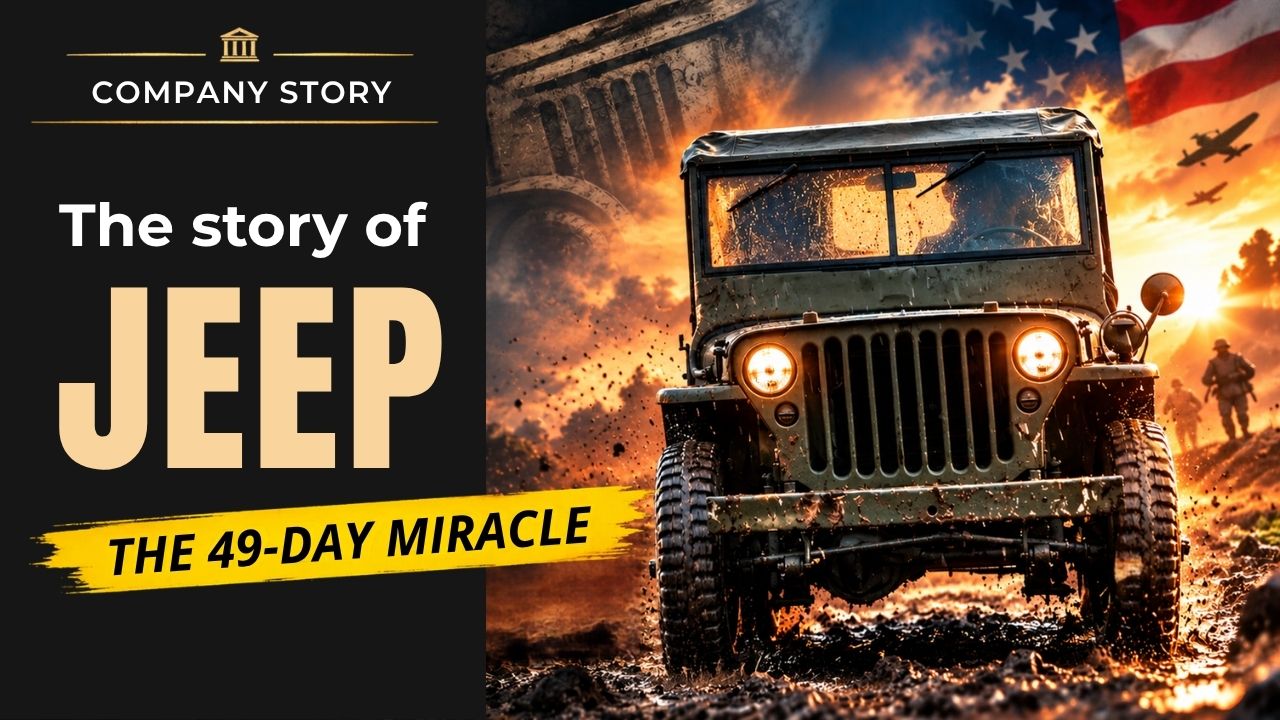
Look at this machine. Covered in mud, battered by impacts, and stripped of all comfort. It was never designed to be luxurious. It was never designed to be sleek. It was designed to survive just long enough to serve a military purpose during the Second World War.
It was a cheap, mass-produced tool of war with a battlefield life expectancy sometimes measured in weeks. And yet somehow, this vehicle—which some military officials considered to be a disposable machine—survived the Second World War and the peace that followed it.
It evolved from a battlefield workhorse into one of the most recognizable automotive brands on Earth, eventually becoming a crown jewel inside a multi-billion-dollar global conglomerate.
Welcome to Business History. Today, we break down the incredible story of Jeep. From the forgotten pioneers of four-wheel drive to a frantic 49-day military deadline, this is the story of the industrial machine that transformed a tiny reconnaissance vehicle into a global icon of mobility, wartime logistics, and American manufacturing power.
Chapter 1: The quest for traction
If you thought the Jeep was the world’s first four-wheel-drive vehicle… think again. The quest for traction began decades before the Second World War.
At the end of the nineteenth century, roads across much of the world were still primitive. Dirt tracks turned into swamps after rain, and heavy cargo vehicles routinely became trapped in mud. The modern automobile industry was still experimental, and engineers everywhere were trying to solve the exact same problem: How do you move a vehicle efficiently across difficult terrain?
In 1893, pioneering English inventor Bramah Joseph Diplock patented one of the earliest four-wheel-drive systems for a steam-powered traction engine. Yes—a steam-powered vehicle! All four wheels were powered, and the machine featured four-wheel steering. Remarkably, the design used three separate differentials, allowing the vehicle to turn sharp corners without tearing itself apart mechanically.
It was an extraordinary innovation for its time, but the technology remained expensive, heavy, and impractical for large-scale commercial use.
The electric and petrol pioneers
Then came a young engineer named Ferdinand Porsche. Long before he became associated with high-performance sports cars, Porsche was experimenting with electric vehicles. Between 1899 and 1900, he developed the Lohner-Porsche—one of the world’s earliest electric all-wheel-drive vehicles.
At the time, electric cars were actually seen as superior to petrol vehicles. Early gasoline engines were noisy, unreliable, and physically dangerous to start. Drivers often had to manually crank the engine from the front of the vehicle. If the engine backfired, the crank could violently reverse direction, causing broken fingers, wrists, and even severe shoulder injuries.
Then, in 1903, two Dutch brothers created one of the most advanced cars on Earth. Jacobus and Hendrik-Jan Spijker (later known internationally as Spyker) built the Spyker 60 H.P. That vehicle became the world’s first petrol-powered four-wheel-drive production car. It featured:
- Full-time four-wheel drive
- Four-wheel brakes
- A six-cylinder engine
Many of these features would not become common for decades. The world already possessed the technology that would eventually define vehicles like the Jeep. But it lacked something else: A reason powerful enough to mass-produce it.
Chapter 2: The 49-day miracle
When the First World War broke out in 1914, armies still relied heavily on horses, trains, and slow two-wheel-drive vehicles. But once those machines reached the devastated, muddy battlefields of Europe, many became nearly useless.
By the time the Second World War erupted in 1939, warfare had changed. Armies were no longer fighting static trench battles. Modern combat demanded speed, mobility, rapid communication, and fast-moving logistics.
The U.S. Army realized it needed something new: A lightweight reconnaissance vehicle capable of crossing mud, hills, rivers, and rough terrain while carrying troops, weapons, and equipment. And they needed it immediately.
The Army contacted 135 companies. The requirement was stringent: Deliver a working prototype in just 49 days.
Most manufacturers considered the timeline impossible. Willys-Overland asked for more time. The Army refused. That left only a tiny, struggling company: The American Bantam Car Company.
An impossible deadline
Bantam lacked both resources and engineering manpower. Desperate, the company turned to freelance engineer Karl Probst, who began work on July 17, 1940—initially without salary.
What happened next became one of the most extraordinary engineering stories of the twentieth century. In just two days, Probst completed the core blueprints for the Bantam Reconnaissance Car. His strategy was brilliantly practical: instead of inventing entirely new components, he designed the vehicle around existing off-the-shelf automotive parts. Critical drivetrain components came from Spicer Manufacturing (a company that would later become part of Dana Incorporated).
This modular approach dramatically accelerated production. On September 23, 1940, a handmade Bantam prototype arrived at Camp Holabird in Maryland for military testing. Against all expectations… it passed.
A ruthless government decision
The Army finally had the vehicle it needed. But there was one big problem: Bantam was simply too small, and the military feared the company could never mass-produce enough vehicles for a global war.
So, the government made a ruthless decision. The Army invited larger manufacturers—including Willys-Overland and Ford—to develop competing versions based on the general Bantam concept.
After extensive testing, Willys modified the design with its powerful ‘Go Devil’ engine and secured the primary production contract, creating the Willys M.B. Ford contributed key manufacturing refinements, including the now-iconic pressed steel grille. Because the military needed overwhelming production capacity, Willys granted the government a non-exclusive license allowing Ford to manufacture nearly identical Jeeps.
And just like that, the tiny reconnaissance vehicle became a fully industrialized wartime product. Meanwhile, Bantam—the company that made the original breakthrough possible—was largely sidelined, building only around 2,700 vehicles before shifting to military trailer production.
The 49-day miracle had changed history, but the company behind it would never fully reap the rewards.
Chapter 3: The engine of mobility
Between Willys and Ford, America produced roughly 640,000 Jeeps during the war. It represented nearly 18% of all wheeled military vehicles manufactured by the United States.
The Jeep was not a battle tank. But, in some ways, it was arguably more important. It was a flexible logistics platform. The vehicle featured:
- A 60-horsepower four-cylinder engine
- A rugged four-wheel-drive system
- A three-speed manual transmission
- A lightweight steel body with no doors
- A fold-down windshield and removable canvas roof
Everything about the design prioritized simplicity, reparability, and mobility. Its versatility became legendary. The Jeep carried machine guns, towed anti-tank weapons, transported wounded soldiers, and laid communication cables. It served as a mobile radio station, ambulance, water pump, tractor, and reconnaissance platform. Some Jeeps were even modified to operate directly on railway tracks.
The global manufacturing war
The Jeep’s true dominance came not just from design, but from industrial scale.
Germany fielded its own highly capable military utility vehicle: the Kübelwagen (designed by Ferdinand Porsche and built by Volkswagen). It was lighter, fuel-efficient, and mechanically simpler. But Germany could not match American industrial production; only around 50,000 Kübelwagens were built.
Other nations tried to solve the mobility problem too. Japan developed the Kurogane Type 95. The Soviet Union rushed out the GAZ-64 and GAZ-67 to navigate the brutal Russian mud. Britain deployed the “Tilly”—modified commercial pickup trucks.
But none of these rivals could compete with the sheer manufacturing volume of Detroit.
Not every Jeep experiment succeeded. Ford developed an amphibious version called the G.P.A. (nicknamed the ‘Seep’), but balancing off-road performance with amphibious capability proved difficult. Still, on land, the Jeep became indispensable. General Dwight D. Eisenhower later identified the Jeep as one of the key vehicles that helped secure Allied operational mobility during the war.
It represented something larger than a vehicle. It was a system that streamlined supply chains, procurement, and mass industrial organization.
Conclusion: The corporate evolution
When the war ended, the Jeep faced an entirely different challenge: How do you transform a wartime machine into a peacetime business?
Willys began adapting the Jeep for civilian use, targeting farmers, construction crews, foresters, and explorers. The Jeep’s rugged image suddenly became commercially valuable. Over time, the brand evolved from a military utility vehicle into a lifestyle product associated with adventure, toughness, and freedom.
But the company behind Jeep changed repeatedly. Over decades, the brand passed through a chain of corporate mergers and acquisitions. Today, Jeep operates under Stellantis—one of the world’s largest automotive conglomerates—alongside brands like Fiat, Peugeot, Chrysler, Citroën, and Opel.
Modern Jeeps barely resemble the stripped-down wartime vehicles that drove across Europe during the 1940s. Today’s versions are packed with luxury interiors, touchscreens, advanced suspension systems, and electronic driving assistance as they compete in an intensely crowded global SUV market.
But the mythology of the vehicle has survived. The Jeep began as a disposable military tool built for a global emergency. Instead, it became one of the most enduring symbols of mobility, industrial power, and wartime manufacturing ever created. And more than 80 years later, its legacy still drives forward.
If you enjoy exploring the industries, rivalries, and supply chains that shaped the modern world, make sure to [Subscribe to the Business History YouTube Channel]!